
It Was Never the Tech
What centuries of panic about new technologies can teach us

Explore the interactive companion to this piece: a visual timeline of technology panics in education, including fears, intensities, what evidence eventually showed, patterns, and data at:
https://exploreedtech.org
Every generation is warned that a new technology will ruin how children think. What is striking, once the warnings are lined up, is how little the script changes. When Socrates worried in the Phaedrus that writing would hollow out memory and manufacture the appearance of wisdom without its substance, he was making almost exactly the complaint heard in school staff rooms about students submitting AI-generated essays they cannot explain (Ong, 1982). The oldest panic on record contains the newest one, nearly word for word.
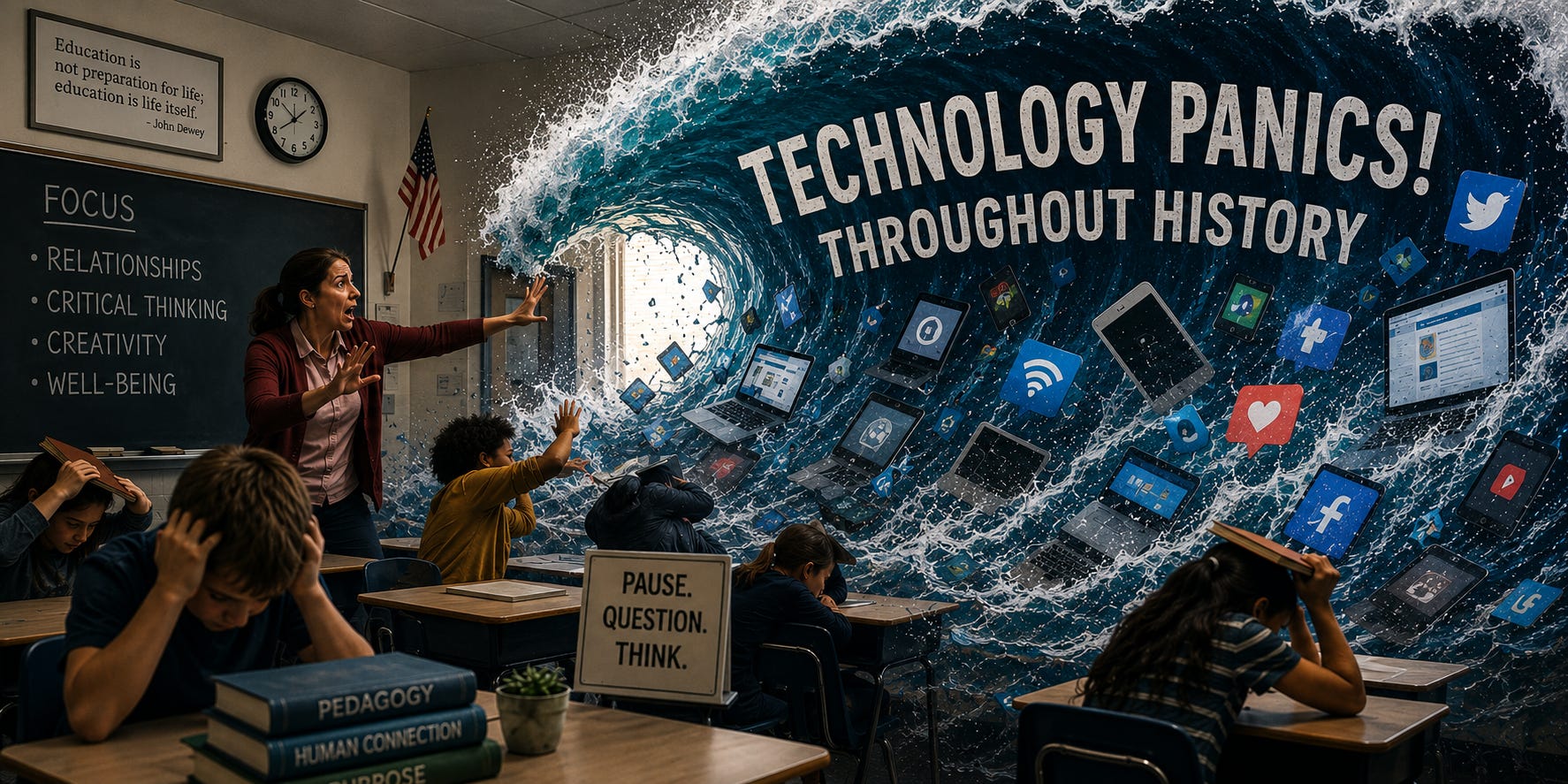
The useful question, then, is not “is this dangerous?” It is why the same anxiety returns in the same shape, and what, if anything, is genuinely different this time, with the advent of generative AI.
One Variable Explains it
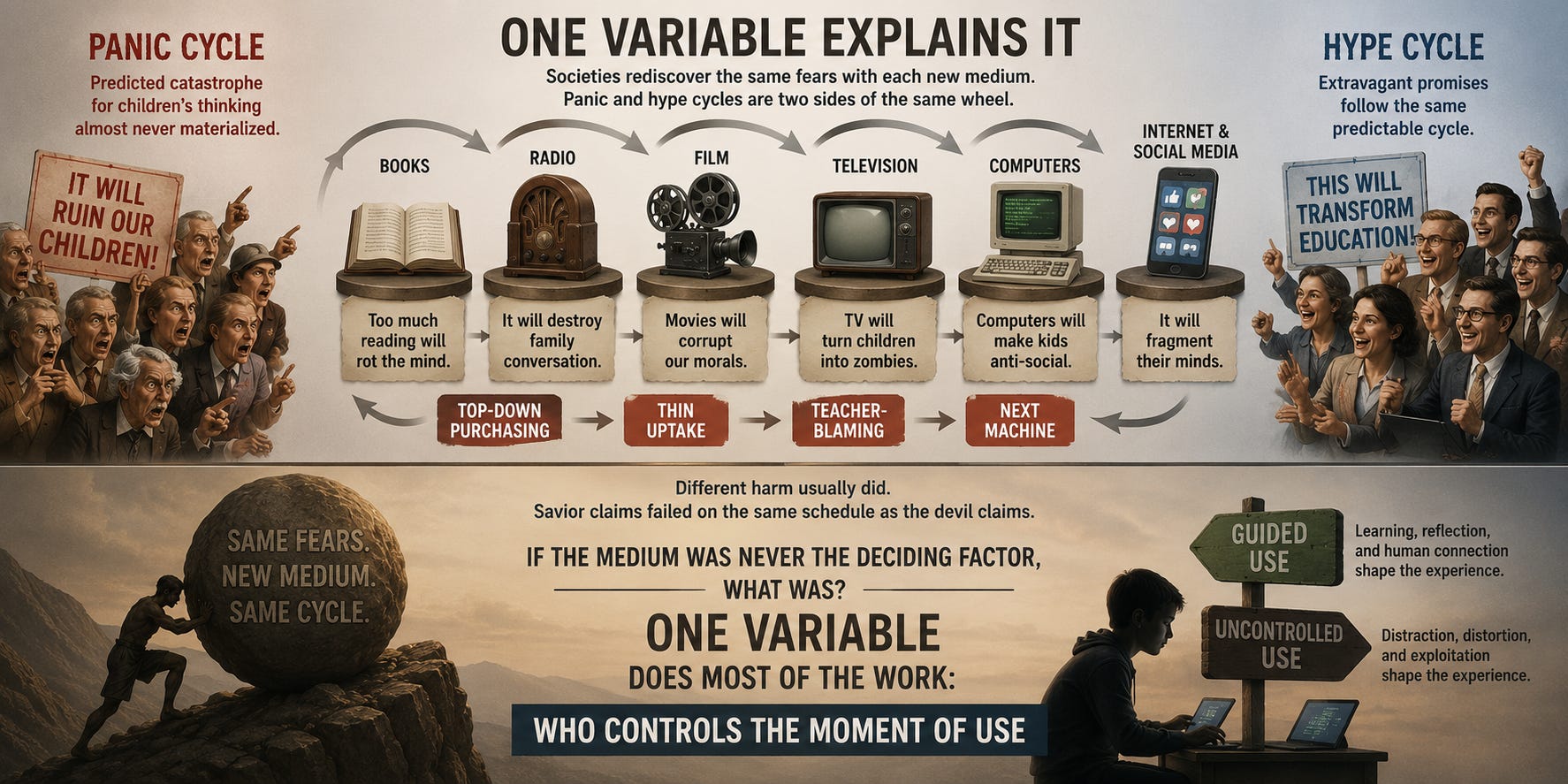
Amy Orben describes the Sisyphean cycle: societies rediscover an identical set of fears with each new medium, then fail to build better research habits before the next one arrives (Orben, 2020). Larry Cuban documented the mirror image inside schools, tracing extravagant promises for film, radio, television, and computers, each followed by top-down purchasing, thin uptake, teacher-blaming, and the next machine (Cuban, 1986). Panic and hype cycles are two sides of the same wheel. Predicted catastrophe for children’s thinking almost never materialized, a different harm usually did, and the savior claims failed on the same schedule as the devil claims.
If the medium was never the deciding factor, what was? One variable does most of the work:
who controls the moment of use
I explored and qualitative coded 67 technologies. Of those inciting a clear fear about learning or cognition, 20 of 23 were technologies children operated autonomously. Of the 27 that schools controlled, only one carried a learning fear at all, and it never rose above professional grumbling. Every technology that prompted intense fears, from novels to television to smartphones and generative AI, was child-controlled.
The Computer that No One Feared
The school computer arrived with the most extravagant claims in the history of educational technology, consumed enormous budgets, restructured curricula, and put a networked screen in front of nearly every child in the developed world. Then the evidence came in. A randomized trial of one-laptop-per-child in Peru raised computers per student roughly tenfold and moved neither mathematics nor language scores, and the OECD found no appreciable improvement in the countries that had invested most heavily in classroom technology (Cristia et al., 2017; OECD, 2015). Yet there were no marches on the computer lab. No hearings about the school desktop, no bestselling books warning the Chromebook was rewiring children’s brains. Why? Because the school bought it, the teacher decided when it opened, and an adult could see the screen.
Now move the same machine. Under a teacher’s eye, it provokes nothing. In a family living room, bought by parents and used in plain sight, the worry stays mild. Shrink it and slide it into a teenager’s pocket, and you get the most intense education panic in living memory, with a real cognitive mechanism underneath it. The mere presence of one’s own phone measurably reduces available cognitive capacity (Ward et al., 2017).
The hardware barely changed. A managed Chromebook and a smartphone are the same-era silicon running the same internet. What changed was who was holding it. Meanwhile the one unambiguous success in the record, Sesame Street, produced substantial early learning gains, largest for disadvantaged children, because it was built on relentless formative research rather than distributed and hoped over (Bogatz & Ball, 1971; Kearney & Levine, 2019). Design, not the screen, drives cognition.
Four Engines: AI Fires All of Them
Autonomy alone gives you a moral panic, not a cognitive one. Rock & roll and Dungeons & Dragons were feared for children’s souls, not their minds, and carried no claim that children would learn less.
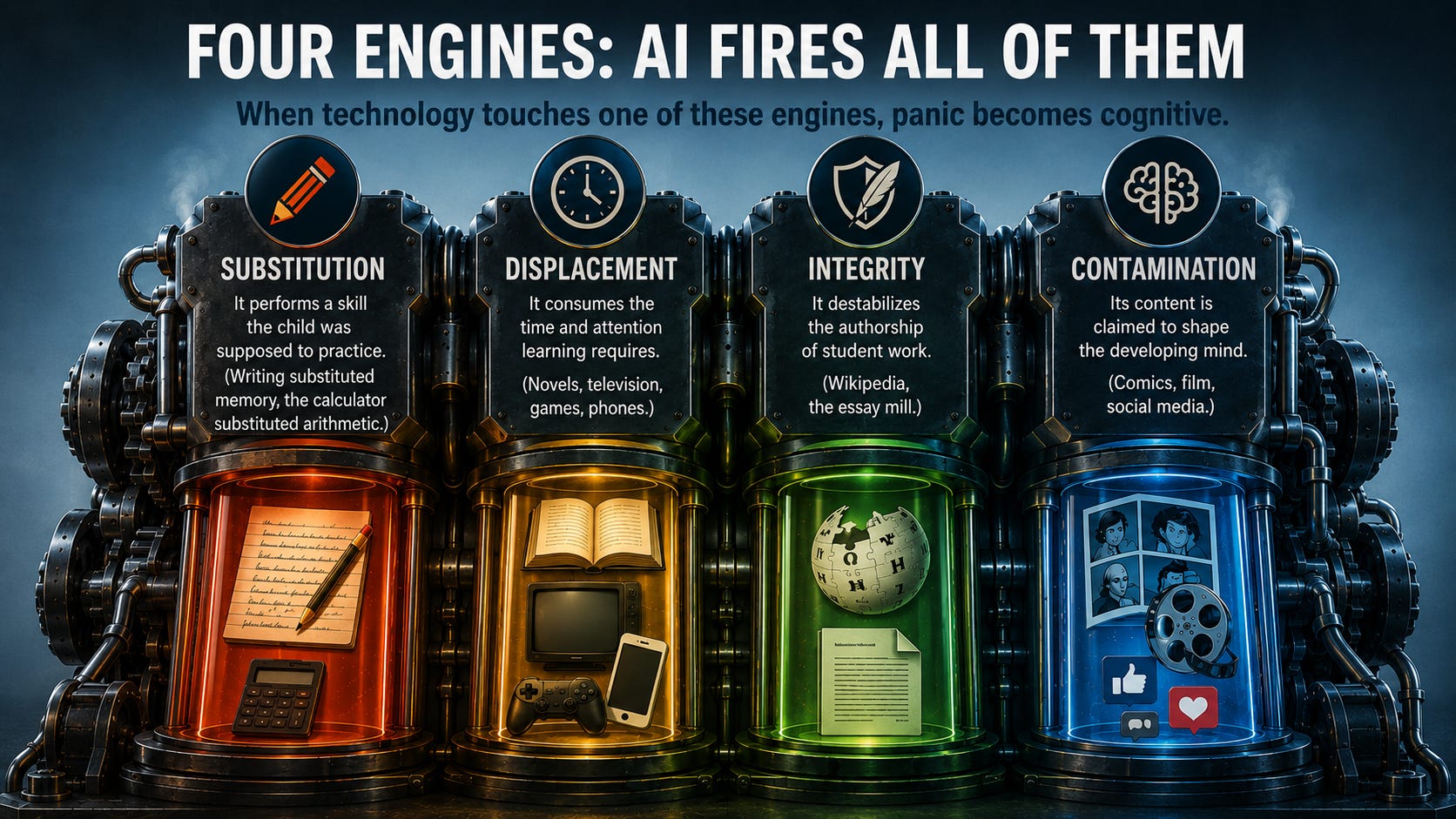
A panic becomes cognitive only when a technology engages one of four engines:
Substitution: It performs a skill the child was supposed to practice (writing substituted memory, the calculator substituted arithmetic).
Displacement: It consumes the time and attention learning requires (e.g. novels, television, games, phones)
Integrity: It destabilizes the authorship of student work (Wikipedia, the essay mill).
Contamination: Its content is claimed to shape the developing mind (comics, film, social media).
Within substitution sits a gradient that predicts intensity with unnerving accuracy: the panic scales with how central the substituted skill is to assessment. GPS substitutes a skill nobody grades, and never rose above mild self-help discourse. The calculator substituted arithmetic, the heart of the curriculum, and produced a decade-long fight that reached exam boards and ministries. Socrates’ panic hit memory, which in an oral culture was not merely a skill but the assessed skill.
AI is the first technology in the record to fire all four engines at once.
It substitutes writing, reasoning, and argument construction, which are not peripheral skills but the assessed skills, across every subject simultaneously. It displaces effortful practice in a novel way, because it doesn’t merely compete for a student’s hours as television did, it hollows them out, so the homework is still submitted while the thinking to produce it never happens (Kosmyna et al., 2025). It detonates integrity, and unlike earlier authorship crises there is no technical fix, as AI-text detectors are neither accurate nor reliable (Weber-Wulff et al., 2023; Eaton, 2023). And it contaminates, through synthetic content and misinformation aimed at children. Add an adoption curve faster than adults could acquire fluency (Orben, 2020) and an interface in which the teacher cannot see the prompt, and the recipe is complete.
You need not assume anything unprecedented about large language models to explain the scale of the alarm. Four engines, maximum assessment-centrality, full child autonomy, and a fluency gap: the same machinery that drove every panic on the list, running at maximum output for the first time.
Genuine Concern: Cognitive Offloading in Developing Minds
Explaining a panic is not the same as dismissing it, and one concern deserves to be taken seriously rather than waved away with history: cognitive offloading in young, developing minds.
Offloading a skill you already possess to a calculator or a search engine redistributes developed capacity (Sparrow et al., 2011). Offloading a skill a child has not yet built is a different proposition. The effortful practice may be precisely how the underlying architecture forms. Memory, reasoning, and argument construction are built through use, and the developmental windows in which they are built do not stay open indefinitely. This where “AI is just the latest calculator” may fail as an analogy, and it is why the age of the child, rather than the capability of the model, should be the variable that governs policy.
The evidence is suggestive rather than settled, so an honest stance is precautionary. Tellingly, the AI interventions producing real learning gains all embed the tool inside guided, effortful, human-led practice (De Simone et al., 2025; Kestin et al., 2025), while the studies raising alarms concern unguided use (Kosmyna et al., 2025). The tool should follow skill formation, not replace it, and the younger the learner, the more that ordering matters.
These panics never end when the evidence arrives. They end when institutions re-establish control over the technology’s classroom form: the calculator and non-calculator exam paper, the bell-to-bell phone ban now sweeping education systems worldwide (Beland & Murphy, 2016; UNESCO, 2023), and, next, guard-railed AI with assessment redesigned around what students can do unaided.
The experiment has run repeatedly over centuries. It was never the machine- it was always the pedagogy, the teacher, and the question of who was holding the device.
References
Beland, L.-P., & Murphy, R. (2016). Ill communication: Technology, distraction and student performance. Labour Economics, 41, 61–76. https://doi.org/10.1016/j.labeco.2016.04.004
Bogatz, G. A., & Ball, S. (1971). The second year of Sesame Street: A continuing evaluation. Educational Testing Service.
Cristia, J., Ibarrarán, P., Cueto, S., Santiago, A., & Severín, E. (2017). Technology and child development: Evidence from the One Laptop per Child program. American Economic Journal: Applied Economics, 9(3), 295–320. https://doi.org/10.1257/app.20150385
Cuban, L. (1986). Teachers and machines: The classroom use of technology since 1920. Teachers College Press. https://archive.org/details/teachersmachines0000cuba
De Simone, M., Tiberti, F., Barron Rodriguez, M., Manolio, F., Mosuro, W., & Dikoru, E. (2025). From chalkboards to chatbots: Evaluating the impact of generative AI on learning outcomes in Nigeria (Policy Research Working Paper No. 11125). World Bank. https://documents.worldbank.org/…/099548105192529324
Eaton, S. E. (2023). Postplagiarism: Transdisciplinary ethics and integrity in the age of artificial intelligence and neurotechnology. International Journal for Educational Integrity, 19, Article 23. https://doi.org/10.1007/s40979-023-00144-1
Kearney, M. S., & Levine, P. B. (2019). Early childhood education by television: Lessons from Sesame Street. American Economic Journal: Applied Economics, 11(1), 318–350. https://doi.org/10.1257/app.20170300
Kestin, G., Miller, K., Klales, A., Milbourne, T., & Ponti, G. (2025). AI tutoring outperforms in-class active learning. Scientific Reports, 15, 17458. https://www.nature.com/articles/s41598-025-97652-6
Kosmyna, N., Hauptmann, E., Yuan, Y. T., Situ, J., Liao, X.-H., Beresnitzky, A. V., Braunstein, I., & Maes, P. (2025). Your brain on ChatGPT: Accumulation of cognitive debt when using an AI assistant for essay writing task (arXiv:2506.08872). https://arxiv.org/abs/2506.08872
OECD. (2015). Students, computers and learning: Making the connection. OECD Publishing. https://doi.org/10.1787/9789264239555-en
Ong, W. J. (1982). Orality and literacy: The technologizing of the word. Methuen. https://archive.org/details/oralityliteracyt0000ongw
Orben, A. (2020). The Sisyphean cycle of technology panics. Perspectives on Psychological Science, 15(5), 1143–1157. https://doi.org/10.1177/1745691620919372
Sparrow, B., Liu, J., & Wegner, D. M. (2011). Google effects on memory: Cognitive consequences of having information at our fingertips. Science, 333(6043), 776–778. https://doi.org/10.1126/science.1207745
UNESCO. (2023). Global education monitoring report 2023: Technology in education: A tool on whose terms? UNESCO. https://www.unesco.org/gem-report/en/publication/technology
Ward, A. F., Duke, K., Gneezy, A., & Bos, M. W. (2017). Brain drain: The mere presence of one’s own smartphone reduces available cognitive capacity. Journal of the Association for Consumer Research, 2(2), 140–154. https://doi.org/10.1086/691462
Weber-Wulff, D., Anohina-Naumeca, A., Bjelobaba, S., Foltýnek, T., Guerrero-Dib, J., Popoola, O., Šigut, P., & Waddington, L. (2023). Testing of detection tools for AI-generated text. International Journal for Educational Integrity, 19, Article 26. https://doi.org/10.1007/s40979-023-00146-z
Disclosure: This piece was researched, drafted, and fact-checked with the help of Claude (Anthropic).